

Plastisphere paradox: How microplastic garbage patches could hold the key to their own cleanup
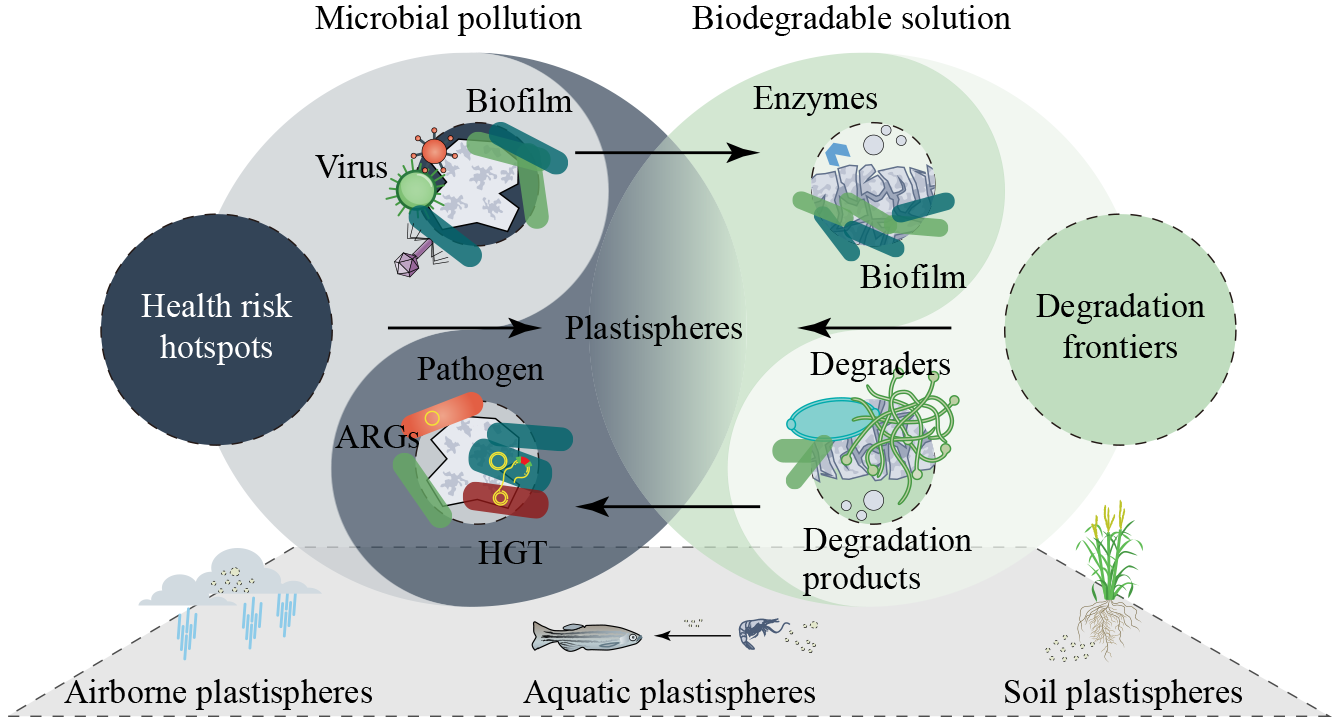
The Plastisphere’s Double Edge: Microbial Hazards and Biodegradation Opportunities.
GA, UNITED STATES, July 9, 2026 /EINPresswire.com/ -- Microplastics—plastic fragments smaller than five millimeters—have become a planetary threat, infiltrating oceans, soils, and even the air we breathe. Their surfaces harbor complex microbial communities known as the plastisphere, which act as dangerous vectors for pathogens and antibiotic resistance genes (ARGs). Yet within these same biofilms lie microorganisms with the potential to degrade synthetic polymers. A new review synthesizes this duality and proposes a groundbreaking evaluation framework to identify degrader microbes that are both highly efficient and environmentally safe, shifting the paradigm from pure risk assessment toward integrated, solution-driven bioremediation.
Over recent decades, microplastics have been found everywhere—from deep-sea sediments to mountain soils. These particles are more than passive debris; they actively collect environmental pollutants and host dense biofilms. Research shows that the plastisphere can enrich antibiotic-resistant bacteria, with resistance gene abundances often three times higher than in surrounding waters. At the same time, scientists have identified plastic-degrading enzymes in these communities, including strains from insect guts such as wax moth and mealworm larvae that can break down polyethylene (PE) and polystyrene (PS). However, the coexistence of these hazardous and beneficial functions has mostly been studied separately. Based on these challenges, there is a critical need for an integrated framework that systematically balances degradation capability with biosafety.
A team of researchers from the Chinese Academy of Sciences, Westlake University, the University of Warmia and Mazury in Poland, and the Technical University of Munich in Germany published their findings in ENGINEERING Environment on May 21, 2026. Their comprehensive review not only maps the ecological threats posed by the plastisphere but also introduces a two-dimensional screening strategy to safely harness its microbial resources, aiming to guide the selection of microbial consortia that degrade plastics without spreading antimicrobial resistance (AMR).
The review details how the plastisphere operates as a double-edged actor. On one side, microplastics serve as mobile vectors, facilitating horizontal gene transfer (HGT) of antibiotic resistance genes (ARGs), including those associated with Pseudomonas and Vibrio species, while also carrying human viruses such as norovirus and enterovirus. They leach chemical additives and adsorb heavy metals, driving the co-selection of resistance traits. On the flip side, researchers highlight powerful degraders like Ideonella sakaiensis, which uses enzymes such as PETase to break down polyethylene terephthalate (PET). Insect gut microbiomes—from wax moths, mealworms, and fall armyworms—have emerged as unexpected sources of microbes capable of attacking PE, PS, and even polyvinyl chloride (PVC). Cutting-edge technologies—including artificial intelligence (AI) for enzyme discovery, single-cell Raman spectroscopy for tracking active degraders in situ, and synthetic microbial consortia (SynComs)—are accelerating the identification of these organisms. The paper's standout contribution is a two-axis evaluation matrix that plots candidates by degradation efficiency versus microbial risk. This framework identifies "Ideal Candidates" for open application while restricting "Effective but Risky" organisms to closed bioreactor systems, ensuring safety by design.
The authors stressed that the scientific community has long viewed the plastisphere through separate lenses. "We tend to study either the risks or the solutions in isolation, but nature doesn't work that way," they said. "Our framework forces us to consider both sides simultaneously. Finding a microbe that breaks down PET is encouraging, but if it carries antibiotic resistance genes and can spread widely, we've only traded one crisis for another. This is why we need to design bioremediation strategies with safety in mind from the very beginning—not as an afterthought."
This framework offers a practical decision-making tool for environmental managers, helping prioritize organisms that are both potent and benign. It also guides the bioengineering of "Safe but Inefficient" strains into more powerful agents. The review further advocates integrating microbial solutions with chemical or physical pretreatments and implementing robust environmental monitoring using quantitative molecular tools such as targeted qPCR and metagenomics. Ultimately, this dual-dimensional evaluation supports a circular bioeconomy, transforming plastic waste from an environmental burden into a valuable feedstock for producing bioproducts, while ensuring that ecological risks are contained from the outset.
References
DOI
10.1007/s11783-026-2234-5
Original Source URL
https://doi.org/10.1007/s11783-026-2234-5
Funding information
This study was financially supported by the National Natural Science Foundation of China (Nos. 22241603, 42177368, and 22206184) and the Natural Science Foundation of Fujian Province, China (No. 2024J09057).
Lucy Wang
BioDesign Research
email us here
Legal Disclaimer:
EIN Presswire provides this news content "as is" without warranty of any kind. We do not accept any responsibility or liability for the accuracy, content, images, videos, licenses, completeness, legality, or reliability of the information contained in this article. If you have any complaints or copyright issues related to this article, kindly contact the author above.
