

Biogas Upgrading Technology Industry Growth Driven by Circular Economy and Clean Energy Goals
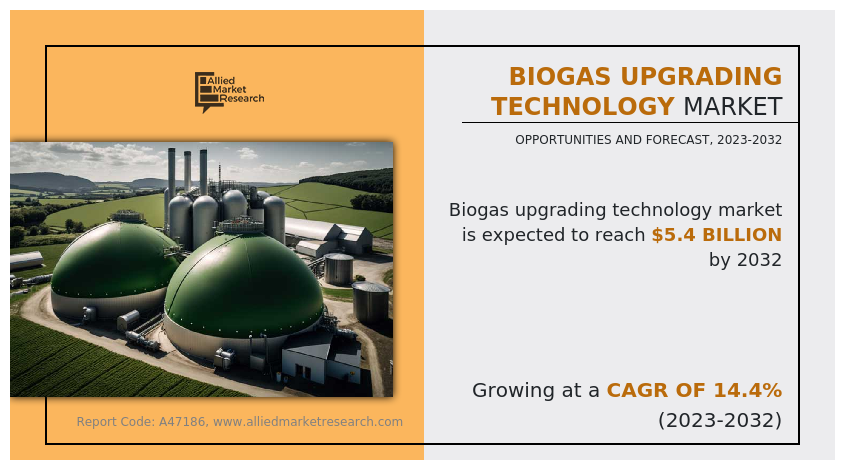
Biogas upgrading technology market is projected to reach $5.4 billion by 2032, driven by biomethane demand and clean energy goals.
Growing renewable energy investments and biomethane adoption are accelerating global biogas upgrading technology market growth.”
WILMINGTON, DE, UNITED STATES, June 3, 2026 /EINPresswire.com/ -- — Allied Market Research
The global biogas upgrading technology market is witnessing remarkable growth as governments, industries, and energy providers increasingly focus on reducing carbon emissions and accelerating the transition toward renewable energy sources. According to a recent report published by Allied Market Research, the biogas upgrading technology market size was valued at $1.4 billion in 2022 and is projected to reach $5.4 billion by 2032, registering a CAGR of 14.4% from 2023 to 2032.
The rapid expansion of the renewable energy sector, coupled with increasing environmental awareness and stricter regulations regarding greenhouse gas emissions, is creating favorable conditions for the growth of the biogas upgrading technology market. As countries strive to achieve ambitious climate targets, biomethane production is emerging as a sustainable solution that supports energy security while reducing dependence on fossil fuels.
Download PDF Brochure: https://www.alliedmarketresearch.com/request-sample/A47186
Understanding Biogas Upgrading Technology
Biogas upgrading technology refers to advanced systems designed to convert raw biogas into high-purity biomethane. Raw biogas is generally generated through the decomposition of organic materials such as agricultural waste, food waste, animal manure, and sewage sludge. While raw biogas contains methane, it also includes impurities such as carbon dioxide, hydrogen sulfide, water vapor, and trace gases.
The primary purpose of biogas upgrading technology is to remove these unwanted components and produce biomethane that meets the quality standards required for transportation, industrial applications, power generation, and injection into natural gas grids. This process enhances the value of biogas while enabling its integration into existing energy infrastructure.
As renewable energy continues to gain momentum globally, the importance of biogas upgrading technology is becoming increasingly evident. The technology supports circular economy principles by transforming waste streams into valuable energy resources while simultaneously reducing environmental impacts.
Growing Importance of Biomethane in the Global Energy Mix
The increasing demand for cleaner energy alternatives has significantly boosted interest in biomethane production. Biomethane offers several advantages compared to conventional fossil fuels, including lower carbon emissions, improved waste management, and enhanced energy diversification.
Biomethane generated through biogas upgrading technology can be utilized across multiple sectors. It can serve as a renewable fuel for transportation, a substitute for natural gas in industrial processes, and a sustainable energy source for residential heating applications. The versatility of biomethane makes it an attractive option for countries seeking to decarbonize their economies without requiring extensive modifications to existing gas infrastructure.
Furthermore, energy companies and governments are recognizing biomethane as a critical component in achieving net-zero emission objectives. This recognition is expected to strengthen investments in biogas upgrading technology over the coming decade.
Key Factors Driving the Biogas Upgrading Technology Market
One of the primary drivers supporting the growth of the biogas upgrading technology market is the increasing emphasis on renewable energy generation. Governments worldwide are implementing supportive policies, financial incentives, and regulatory frameworks that encourage the adoption of sustainable energy technologies.
The growing awareness of climate change and environmental sustainability has also encouraged industries to invest in cleaner energy alternatives. Companies are increasingly looking for solutions that reduce carbon footprints while improving resource efficiency. Biogas upgrading technology provides an effective pathway to achieve these goals.
Agricultural industries are another major contributor to market growth. Farms generate substantial quantities of organic waste that can be converted into biogas and subsequently upgraded into biomethane. This approach not only creates an additional revenue stream for farmers but also helps address waste disposal challenges.
In addition, urbanization and industrialization are increasing the demand for effective waste management solutions. Waste-to-energy projects utilizing biogas upgrading technology are becoming more common as municipalities seek environmentally responsible methods to manage organic waste.
Role of Circular Economy Initiatives
Circular economy principles are playing a significant role in expanding the biogas upgrading technology market. Unlike traditional linear economic models that generate substantial waste, circular economy systems focus on resource recovery and reuse.
Biogas upgrading technology aligns perfectly with these principles by converting waste materials into valuable energy products. Organic waste from households, agriculture, food processing industries, and wastewater treatment plants can be transformed into renewable biomethane, thereby reducing landfill dependency and methane emissions.
This ability to create economic value from waste is attracting investments from both public and private sectors. As circular economy initiatives continue to gain global acceptance, demand for biogas upgrading technology is expected to rise substantially.
Government Regulations Supporting Market Expansion
Government regulations and renewable energy targets are creating strong growth opportunities for the biogas upgrading technology market. Numerous countries have introduced policies designed to increase renewable energy generation while reducing greenhouse gas emissions.
In Europe, renewable energy directives have played a crucial role in accelerating biomethane production. European nations continue to invest heavily in biogas infrastructure to meet sustainability objectives and reduce dependence on imported fossil fuels.
Similarly, countries across North America and Asia-Pacific are implementing programs that encourage renewable natural gas production. Financial incentives, tax benefits, and grants are helping project developers adopt biogas upgrading technology more efficiently.
These supportive regulatory frameworks are expected to remain a key growth catalyst throughout the forecast period.
Procure This Report (340 Pages PDF with Insights, Charts, Tables, and Figures): https://www.alliedmarketresearch.com/biogas-upgrading-technology-market/purchase-options
Challenges Facing the Biogas Upgrading Technology Market
Despite strong growth prospects, the biogas upgrading technology market faces several challenges. One of the most significant barriers is the high initial capital investment required to establish upgrading facilities.
Advanced purification systems, monitoring equipment, and infrastructure components involve substantial costs, which may discourage smaller organizations from investing in the technology. Additionally, integrating biogas upgrading systems with existing energy networks often requires specialized expertise and technical resources.
Operational and maintenance expenses also present challenges. Regular monitoring, equipment servicing, and compliance with quality standards contribute to overall project costs.
Moreover, increasing digitalization within energy infrastructure has raised concerns regarding cybersecurity vulnerabilities. As biogas upgrading facilities become more connected through IoT-enabled monitoring systems, protecting critical infrastructure from cyber threats becomes increasingly important.
Technology Segment Analysis
The biogas upgrading technology market is segmented into absorption, vacuum pressure swing adsorption, membrane separation, and other technologies.
Absorption technologies continue to be widely adopted due to their effectiveness in removing carbon dioxide and other contaminants from raw biogas. Vacuum pressure swing adsorption systems are also gaining popularity because of their operational efficiency and ability to achieve high methane recovery rates.
Membrane separation technology has emerged as an attractive option for modern upgrading facilities due to its compact design, lower maintenance requirements, and scalability. Continuous technological advancements are improving the performance and cost-effectiveness of membrane-based systems.
The category classified as other technologies is expected to witness the fastest growth during the forecast period. Ongoing research and development activities are leading to the emergence of innovative upgrading solutions that offer improved efficiency and operational flexibility.
End-Use Industry Insights
The biogas upgrading technology market serves various end-use applications, including thermal applications, power generation, and biomethane bottling.
Thermal applications remain important as industries seek sustainable alternatives for heating processes. Power generation facilities are increasingly utilizing upgraded biogas to produce renewable electricity and support grid stability.
However, biomethane bottling is expected to experience the highest growth rate during the forecast period. The increasing use of compressed biomethane as a transportation fuel is creating significant opportunities for this segment. Bottled biomethane provides a convenient and environmentally friendly fuel option that supports decarbonization efforts across transportation networks.
Regional Analysis
Europe dominated the global biogas upgrading technology market in 2022, accounting for more than two-fifths of total revenue. The region’s leadership can be attributed to strong renewable energy policies, advanced waste management infrastructure, and ambitious climate goals.
Countries such as Germany, France, Italy, and the Netherlands have established extensive biomethane production networks, supporting continued market growth throughout the region.
While Europe currently leads the market, Asia-Pacific is expected to register the fastest growth during the forecast period. Rapid industrialization, increasing energy demand, and rising investments in renewable energy projects are driving market expansion across countries such as India, China, and several Southeast Asian nations.
North America is also witnessing steady growth due to increasing adoption of renewable natural gas projects and favorable government initiatives aimed at reducing emissions.
Competitive Landscape
The global biogas upgrading technology market features the presence of several prominent companies focused on technological innovation and market expansion. Major participants include Atmos Power Pvt. Ltd., Bright Renewables B.V., Air Liquide, DMT Environmental Technology, Evonik Industries AG, Pentair Plc, Malmberg Bioerdgastech GmbH, Metener Oy, Greenlane Renewables Inc., Wärtsilä Oyj Abp, Prodeval Corp., Aemetis Inc., Clarke Energy, Acrona Projects Sarl, Clean Energy Fuels Corp., AB Holding Spa, Spectrum Renewable Energy Limited, B-Sustain Energy Projects Private Limited, Xebec Adsorption Inc., and Verbio Vereinigte Bioenergie AG.
These companies are actively investing in product innovation, strategic partnerships, capacity expansion initiatives, and technology development programs to strengthen their competitive positions. Continuous advancements in purification efficiency, operational reliability, and cost optimization are expected to shape future competition within the market.
Get a Customized Research Report: https://www.alliedmarketresearch.com/request-for-customization/A47186
Conclusion
The global biogas upgrading technology market is entering a period of sustained expansion as renewable energy adoption accelerates worldwide. Growing demand for biomethane, supportive government regulations, increasing focus on waste-to-energy projects, and rising investments in sustainable infrastructure are creating significant opportunities for market participants.
Although challenges such as high capital costs and technical complexities remain, the long-term environmental and economic benefits offered by biogas upgrading technology continue to outweigh these barriers. With Europe maintaining its leadership position and Asia-Pacific emerging as a high-growth region, the market is expected to play a vital role in the global transition toward a cleaner, more sustainable energy future.
Trending Reports in Energy and Power Industry:
Biogas Upgrading Technology Market
https://www.alliedmarketresearch.com/biogas-upgrading-technology-market-A47186
Biogas Market
https://www.alliedmarketresearch.com/biogas-market-A08979
Organic Biogas Market
https://www.alliedmarketresearch.com/organic-biogas-market-A31612
Biogas Plant Market
https://www.alliedmarketresearch.com/biogas-plant-market-A07217
Waste-Derived Biogas Market
https://www.alliedmarketresearch.com/waste-derived-biogas-market
Biodiesel Market
https://www.alliedmarketresearch.com/biodiesel-market
Renewable Energy Market
https://www.alliedmarketresearch.com/renewable-energy-market
Waste to Energy Market
https://www.alliedmarketresearch.com/waste-to-energy-market
Green Hydrogen Market
https://www.alliedmarketresearch.com/green-hydrogen-market-A11310
Second Generation Biofuels Market
https://www.alliedmarketresearch.com/second-generation-biofuels-market
Advanced Biofuel Market
https://www.alliedmarketresearch.com/advanced-biofuel-market-A06372
Biofuel market
https://www.alliedmarketresearch.com/biofuel-market-A08574
Coal Gasification Market
https://www.alliedmarketresearch.com/coal-gasification-market-A10737
Gasification Market
https://www.alliedmarketresearch.com/gasification-market
Biomass Gasification Market
https://www.alliedmarketresearch.com/biomass-gasification-market-A09297
About Us
Allied Market Research (AMR) is a full-service market research and business-consulting wing of Allied Analytics LLP based in Portland, Oregon. Allied Market Research provides global enterprises as well as medium and small businesses with unmatched quality of "Market Research Reports" and "Business Intelligence Solutions." AMR has a targeted view to provide business insights and consulting to assist its clients to make strategic business decisions and achieve sustainable growth in their respective market domain.
Pawan Kumar, the CEO of Allied Market Research, is leading the organization toward providing high-quality data and insights. We are in professional corporate relations with various companies and this helps us in digging out market data that helps us generate accurate research data tables and confirms utmost accuracy in our market forecasting. Each and every data presented in the reports published by us is extracted through primary interviews with top officials from leading companies of domain concerned. Our secondary data procurement methodology includes deep online and offline research and discussion with knowledgeable professionals and analysts in the industry.
David Correa
Allied Market Research
+ + + + + + + + + + + + +1 800-792-5285
email us here
Visit us on social media:
LinkedIn
Facebook
YouTube
X
Legal Disclaimer:
EIN Presswire provides this news content "as is" without warranty of any kind. We do not accept any responsibility or liability for the accuracy, content, images, videos, licenses, completeness, legality, or reliability of the information contained in this article. If you have any complaints or copyright issues related to this article, kindly contact the author above.
