

Global Hydrophone Market to Soar by 2033, Driven by Defense, Offshore Energy & Environmental Monitoring
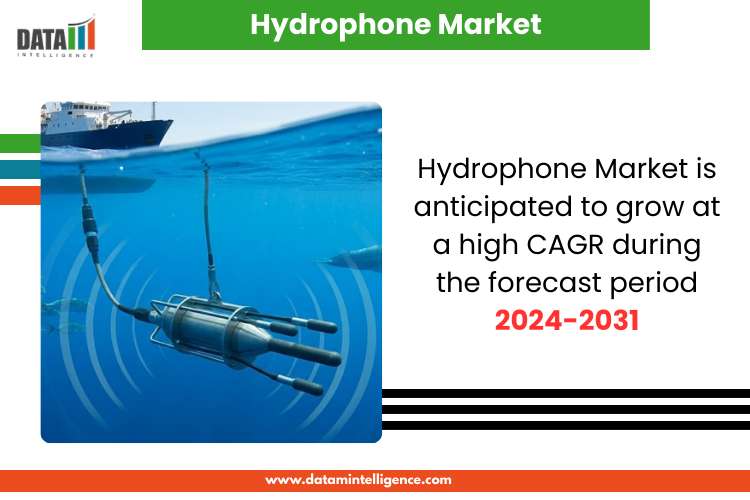
Hydrophone Market
North America leads while Asia-Pacific grows fast; array-based, digital, and AUV-integrated hydrophones drive near-term market expansion.
Hydrophones are shaping underwater research and surveillance, enabling defense, renewable energy, and environmental monitoring with digital precision.”
AUSTIN, TX, UNITED STATES, March 9, 2026 /EINPresswire.com/ -- According to DataM Intelligence, the hydrophone market is expected to maintain steady mid-single to double-digit growth over the forecast period 2026–2033. The market’s expansion is underpinned by consistent defense procurement cycles, recurring environmental monitoring requirements, and increasing offshore activity in wind, energy, and subsea infrastructure. Array-based systems, digital architectures, and long-duration monitoring deployments, such as seabed and moored solutions, are likely to lead near-term growth. North America currently leads the market due to strong defense spending, ocean research infrastructure, and early adoption of advanced array and digital hydrophone systems.— DataM Intelligence
𝗚𝗲𝘁 𝗮 𝗦𝗮𝗺𝗽𝗹𝗲 𝗣𝗗𝗙 𝗕𝗿𝗼𝗰𝗵𝘂𝗿𝗲 𝗼𝗳 𝘁𝗵𝗲 𝗥𝗲𝗽𝗼𝗿𝘁 (𝗨𝘀𝗲 𝗖𝗼𝗿𝗽𝗼𝗿𝗮𝘁𝗲 𝗘𝗺𝗮𝗶𝗹 𝗜𝗗 𝗳𝗼𝗿 𝗮 𝗤𝘂𝗶𝗰𝗸 𝗥𝗲𝘀𝗽𝗼𝗻𝘀𝗲):
https://www.datamintelligence.com/download-sample/hydrophone-market
Key Highlights from the Report
➤ Hydrophones are increasingly integrated into system-level platforms rather than sold as standalone components.
➤ Digital and networked designs with onboard processing are gaining widespread adoption.
➤ Arrays linear, planar, and volumetric drive significant value in defense, seismic, and subsea monitoring.
➤ ESG compliance and regulatory initiatives for offshore projects are accelerating market demand.
➤ Platform integration with autonomous underwater vehicles (AUVs) and ROVs enhances market growth.
➤ Vendors offering lifecycle support, calibration, and field services capture repeat business in complex deployments.
Market Segmentation
By type, the hydrophone market comprises scalar pressure hydrophones and vector hydrophones. Scalar pressure hydrophones dominate general-purpose monitoring applications, while vector hydrophones are increasingly adopted in scenarios requiring directionality and localization, particularly in defense and advanced research.
By sensing technology, piezoelectric ceramic remains the backbone of commercial hydrophones due to proven performance and cost efficiency. Fiber optic and MEMS hydrophones are gaining traction for high-precision or compact digital sensing applications, while piezoelectric polymer is preferred where mechanical flexibility is critical.
By configuration, single-element hydrophones account for the majority of general-purpose deployments. Arrays, however, represent the fastest-growing segment, offering higher average selling prices per deployment and multi-channel utility. Streamer and cable-based hydrophones continue to serve marine seismic workflows.
By deployment mode, towed systems are essential for defense and seismic activities. Fixed seabed and bottom-mounted hydrophones are expanding for long-term environmental monitoring and subsea infrastructure integrity programs. Moored and buoy-based solutions are growing in PAM, marine construction, and offshore wind monitoring.
By frequency band, low and mid-frequency hydrophones form the volume backbone for monitoring and surveillance, while high-frequency and ultrasonic bands are expanding in specialty industrial and laboratory applications.
By depth rating, shallow and mid-depth hydrophones dominate in unit volumes, whereas deep-water and full-ocean-depth hydrophones are increasingly used for subsea infrastructure and deep-ocean research.
By output, analog hydrophones remain relevant for cost-sensitive deployments, but digital and integrated preamplifier architectures are gaining share in remote monitoring, long cable runs, and synchronized array deployments.
By application, defense and security segments lead in strategic value and procurement resilience. Energy, subsea, and environmental monitoring segments are growing rapidly due to compliance and operational integrity requirements. Geophysical and seismic applications, while cyclical, remain important for high-channel-count demand.
By end-user, government and defense remain the primary buyers, while commercial and industrial sectors expand with offshore wind, subsea infrastructure, and marine operations. Institutional demand grows steadily through research programs and observatory expansions.
Looking For A Detailed Full Report? Get it here:
https://www.datamintelligence.com/buy-now-page?report=hydrophone-market
Regional Insights
North America dominates the hydrophone market owing to robust defense spending, ocean research infrastructure, and adoption of advanced array and digital systems. Europe is witnessing high growth driven by offshore wind development, marine construction monitoring, and regulatory adoption of PAM solutions, which increase demand for buoy, seabed, and moored monitoring solutions. Asia Pacific’s market is expanding due to naval modernization, port and coastal infrastructure development, and growing offshore energy activities, with procurement often favoring scalable and cost-optimized designs. The Middle East and Africa are witnessing selective growth linked to energy and subsea projects, along with coastal infrastructure development. Latin America remains smaller in scale but presents opportunities tied to offshore energy and seismic activity cycles.
Market Dynamics
Market Drivers
The hydrophone market is fueled by increasing underwater research, environmental monitoring demand, advancements in smart miniature and digital sensors, and rising defense and security spending on underwater surveillance.
Market Restraints
High deployment and maintenance costs in harsh marine environments, complex logistics for servicing and calibration, and the burden of managing high-resolution continuous data pose challenges.
Market Opportunities
Expansion of passive acoustic monitoring for biodiversity and ESG compliance, offshore wind and blue economy infrastructure buildout, and increased adoption of autonomous platforms and remote monitoring solutions provide lucrative growth opportunities.
Request For Custom Market Research:
https://www.datamintelligence.com/custom-research
Reasons to Buy the Report
✔ Comprehensive market intelligence on hydrophone types, configurations, and technologies.
✔ Detailed insights into regional and global market trends.
✔ Identification of growth drivers, restraints, and market opportunities.
✔ Strategic analysis of key players and competitive landscape.
✔ Actionable data for investment, procurement, and deployment planning.
Frequently Asked Questions (FAQs)
◆ How big is the global hydrophone market by 2033?
◆ Who are the key players in the hydrophone market?
◆ What is the projected growth rate of hydrophones in defense and energy applications?
◆ Which region is estimated to dominate hydrophone deployments through the forecast period?
◆ What deployment modes are most popular for passive acoustic monitoring?
Company Insights
• Teledyne Technologies Incorporated
• Kongsberg Gruppen ASA
• Sonardyne International Ltd
• Saab AB
• RJE International
• Ocean Sonics Inc
• Brüel & Kjær Sound & Vibration Measurement A/S
• GeoSpectrum Technologies Inc
Recent Developments:
✅ In January 2026, Teledyne Marine expanded its hydrophone portfolio with next-generation broadband sensors for oceanographic research and subsea monitoring. The devices offer higher sensitivity, improved noise filtering, and enhanced durability for deepwater applications. Teledyne continues advancing marine acoustic technologies for scientific and industrial uses.
✅ In December 2025, Aquametrix LLC launched compact hydrophone arrays optimized for environmental monitoring and marine biodiversity studies. The systems provide real-time data acquisition and integration with autonomous underwater vehicles (AUVs). Aquametrix continues strengthening its solutions for precise underwater acoustics.
✅ In November 2025, Benthos Inc. introduced advanced hydrophone networks for offshore energy and defense applications, emphasizing high signal-to-noise performance and remote operability. The technology supports monitoring of marine infrastructure and acoustic events. Benthos continues innovation in subsea acoustic solutions.
Conclusion
The hydrophone market is poised for sustained growth through 2033, driven by defense, energy, and environmental monitoring applications. Technological advancements in digital architectures, array configurations, and integrated sensing systems, along with regulatory and ESG compliance requirements, are creating long-term opportunities. Vendors offering platform-ready solutions, lifecycle support, and robust deployment capabilities are well-positioned to capture significant market share in this evolving underwater sensing ecosystem.
Sai Kiran
DataM Intelligence 4market Research LLP
+1 877-441-4866
sai.k@datamintelligence.com
Visit us on social media:
LinkedIn
YouTube
X
Legal Disclaimer:
EIN Presswire provides this news content "as is" without warranty of any kind. We do not accept any responsibility or liability for the accuracy, content, images, videos, licenses, completeness, legality, or reliability of the information contained in this article. If you have any complaints or copyright issues related to this article, kindly contact the author above.
